
About the CSDDD, Timeline, Requirements and FAQs
The Corporate Sustainability Due Diligence Directive (CSDDD) is European Union legislation designed to ensure that large companies identify and address adverse human rights and environmental impacts within their operations and supply chains.
The original CSDDD (Directive 2024/1760) entered into force on 25 July 2024. However, in March 2026, the EU introduced significant changes through the Omnibus I simplification package. The amended CSDDD (Directive (EU) 2026/470) narrows the number of companies directly in scope, simplifies some due diligence requirements and gives businesses more time to prepare.
Supply chain due diligence hasn't gone away! Companies within scope will still need to identify, prevent, mitigate and address adverse human rights and environmental impacts within their operations and chains of activities.
What has changed under the amended CSDDD?
Some of the most important changes include:
Delayed timelines: EU Member States now have until 26 July 2028 to transpose the amended CSDDD into national law, with the requirements generally applying to in-scope companies from 26 July 2029.
Narrower scope: The employee and turnover thresholds have increased significantly, meaning fewer companies will fall directly within the scope of the CSDDD.
Simplified due diligence: The amended rules place greater emphasis on a risk-based approach and reasonably available information, helping to reduce unnecessary information requests throughout supply chains.
Climate transition plans removed: The requirement for companies to adopt a climate transition plan under the CSDDD has been removed.
Changes to liability and penalties: The harmonised EU civil liability regime has been removed, while the maximum financial penalty has been capped at 3% (down from 5%) of a company's net worldwide turnover in the preceding financial year.
This guide explains the amended scope of the CSDDD, the latest implementation timeline and the requirements businesses need to understand. We also look at practical steps businesses and suppliers can take now to strengthen supply chain due diligence and prepare for the new requirements.
Let's explore what the CSDDD means for you - Key Questions:
CSDDD Scope - Which companies does it apply to?
What is the Timeline for the CSDDD?
What are the CSDDD Requirements for companies?
How will the CSDDD be enforced?
What steps should businesses take for CSDDD Compliance? - it will take time - so start now
Advice for suppliers affected by the Corporate Sustainability Due Diligence Directive (CSDDD)
What are the Key Challenges of the CSDDD for the Fashion Industry?
Does the CSDDD apply to the UK?
How does Supply Chain Mapping Software and other tools help companies meet CSDDD requirements?
What is the CSDDD?
The CSDDD is European Union legislation designed to enforce respect for human rights and the environment throughout the entire supply chain of businesses.
The CSDDD aims to bring a comprehensive and mandatory approach to corporate sustainability.
This important legislation could have a significant financial implication for businesses. Compliance will mandate companies to identify, prevent, mitigate and account for adverse human rights and environmental impacts in their own operations, subsidiaries and supply chains. This includes all upstream business partners, as well as downstream partners involved in distribution, transport, and storage. The amended legislation sets the maximum limit for pecuniary penalties at 3% of net worldwide turnover for the preceding financial year.
Civil liability will largely be governed by national law, with victims able to seek compensation where a company is found liable for damage resulting from a failure to meet its due diligence obligations.
CSDDD Scope - Which Companies does it apply to?
The CSDDD will directly apply to both EU and non-EU companies that operate within the European Union. This includes*:
- EU companies with more than 5,000 employees and a turnover exceeding €1.5 billion worldwide net turnover.
- Non-EU companies with turnover exceeding €1.5 billion net turnover generated in the EU.
- EU companies involved in franchising or licensing agreements, generating royalties of over €75 million, if their turnover surpasses €274 million globally
- Non-EU companies involved in franchising or licensing agreements within the EU, generating royalties of over €22.5 million, if their turnover surpasses €80 million in the EU.
*Source.
Special provisions apply to parent companies and certain exemptions are available under specific conditions.
The final version of the CSDDD includes fewer companies than initially proposed. Earlier drafts covered companies with more than 1000 employees and a €450 million turnover.
The financial sector is not exempt from the CSDDD but its obligations are more limited. Financial firms are required to apply the directive to their own operations and upstream supply chains. However, the financial sector is excluded from the CSDDD’s core downstream due diligence obligations.
The amended CSDDD removed a review clause that allowed the European Commission to reconsider adding the financial sector's downstream activities back into the scope later, effectively maintaining the status quo.
What is the Timeline for the CSDDD?
The CSDDD timeline has changed significantly following the EU's Omnibus I simplification package.
The key dates* businesses should now be aware of are:
- 18 March 2026 – Directive (EU) 2026/470, which amended the CSDDD, entered into force.
- 26 July 2027 – The European Commission is due to publish its main guidelines to help businesses implement the CSDDD.
- 26 July 2028 – EU Member States must adopt and publish the national laws required to implement the amended CSDDD.
- 26 July 2029 – Member States must begin applying the CSDDD requirements to companies within scope.
- 1 January 2030 onwards – CSDDD reporting requirements will apply for financial years beginning on or after this date.
The previous phased implementation timetable has therefore been replaced by a later application date, giving businesses additional time to prepare.
*Source.
What Are the CSDDD Requirements for Companies?
Under the CSDDD, companies within scope must take a risk-based approach to identifying and addressing adverse human rights and environmental impacts across their operations and supply chains.
The amended thresholds mean significantly fewer companies will fall directly within the scope of the CSDDD than under the original Directive.
Broadly, Businesses are required to:
- Identify and assess adverse impacts on the environment and human rights resulting from their operations, subsidiaries and supply chains.
- Integrate due diligence into corporate policies to ensure human rights and environmental risks are considered at every level.
- Prevent and mitigate potential risks within their operations and supply chain, taking appropriate action to bring actual adverse impacts to an end or minimise their extent.
- Engage with stakeholders during the due diligence process, involving them in identifying and addressing risks.
- Establish grievance mechanisms for workers and stakeholders to raise issues if they arise, ensuring accessible channels for reporting concerns.
- Monitor due diligence activities to ensure ongoing compliance and effectiveness of risk mitigation efforts.
- Publicly report on their due diligence via a sustainability report or website.
How will the CSDDD be enforced?
Administrative Supervision: EU member states will be responsible for overseeing compliance with the CSDDD. These authorities will monitor companies' due diligence efforts and can conduct investigations if necessary.
Financial Penalties: Companies that fail to meet their obligations under the CSDDD will face penalties imposed by member states. These penalties may vary depending on the severity of non-compliance. Under the amended legislation, the maximum penalty is capped at 3% of the company’s net worldwide turnover in the preceding financial year.
What Steps Should Businesses Take for CSDDD Compliance? It will take time - so start now
Here are five steps companies can start now to prepare for CSDDD compliance:
- Integrate Due Diligence into Policies and Processes
Update existing policies such as revising codes of conduct, supplier contracts, and internal policies to align with CSDDD requirements. Establish due diligence procedures by creating clear procedures for risk assessment, mitigation, monitoring, and reporting. Finally develop a grievance mechanism by setting up a system for stakeholders to raise concerns about potential violations.
- Map Your Supply Chain
Supply chain mapping and reliable supplier data can help businesses pinpoint higher-risk areas and determine where more detailed assessment and due diligence are required.
A supply chain transparency solution can provide visibility across your n-tier supply chain while helping you gather robust data and evidence. Building this level of transparency takes time, so starting now can help reduce compliance risks and protect your brand.
With the right solution, compliance and compliance reporting can quickly become second nature. We at Segura provide the necessary transparency by mapping your suppliers and the relationships within your supply chain to n-tier.
Segura captures supplier audits, CAPs, certification data, environmental data and audits providing businesses with evidence-based reporting and due diligence they need to comply with legislation.
- Engage with Business Partners
Inform your suppliers and other business partners about the CSDDD and your expectations regarding their compliance. Offer guidance and resources to help your partners meet the required standards. Work together to address identified risks and improve sustainability performance.
- Enhance Transparency and Reporting
Implement systems to gather information on your due diligence activities and the effectiveness of your efforts. Publish a detailed report on your due diligence processes, identified risks, and actions taken.
- Invest in Training
Educate staff on the CSDDD, their roles in ensuring compliance, and how to identify and report potential violations.
"There will be a lot more legislation and reporting requirements coming through. We partnered with Segura because we know they can help us stay ahead of the game"
Are you looking to stay ahead of the game and ensure your company meets the requirements of the EU's CSDDD? Click here to book a free no-obligation review of what Segura can bring to your business today and let us guide you towards a transparent, more sustainable, and compliant future.
Advice for suppliers affected by the Corporate Sustainability Due Diligence Directive (CSDDD)
If you supply businesses that are required to comply with CSDDD, you are very likely to receive more requests for information relating to this;
 Be prepared: Read about the CSDDD and note what it asks of your customers. Get an understanding of what information your customers will need from you, why and when.
Be compliant: Make sure that you are up to date and compliant with all labour, health and safety, and environmental legislation. Make sure the relevant information is ready to share with customers, to help them comply with the new law.
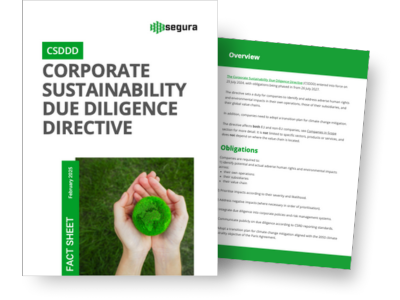
Be empowered: Download our CSDDD Factsheet today to follow our recommended roadmap for compliance.
More FAQs
Does the CSDDD apply to SMEs?
No, the CSDDD does not directly apply to SMEs. However, many SMEs will feel indirect pressure to comply because larger companies within the scope are required to collect detailed due diligence information from their suppliers. This may mean more data requests, increased documentation requirements and the need to meet higher sustainability standards.
Having said this, the EU's Omnibus changes were specifically designed in part to reduce the trickle-down burden on smaller business partners.
Therefore, companies are expected to use reasonably available information when carrying out due diligence, helping to reduce excessive information requests and the knock-on compliance burden for smaller suppliers and business partners.
What Are The Key Challenges Of The CSDDD For The Fashion Industry?
The fashion industry faces significant challenges under the CSDDD due to its complex, globalised and often opaque supply chains. Some brands and retailers work with thousands of suppliers and subcontractors across multiple tiers, making it difficult to map every production stage, trace raw materials and verify working conditions.
Achieving full visibility, particularly beyond tier 1, requires technology, robust data collection and close collaboration with suppliers to ensure accurate and reliable information.
In addition, many fashion supply chains are located in high-risk regions where issues such as forced labour, low wages, unsafe factories and environmental pollution are more prevalent.
Meeting the CSDDD’s due diligence expectations will therefore require brands to strengthen auditing processes, invest in supplier remediation programmes and continuously monitor performance against ethical and sustainability targets.
Fashion companies must also adapt to new reporting obligations and demonstrate that their business models and purchasing practices are aligned with the directive — a significant shift for an industry built on fast, cost-driven production cycles.
Segura helps fashion brands comply with the CSDDD by providing full n-tier supply chain visibility, capturing real-time supplier data, audits, certifications and corrective action plans in one platform. This enables brands to evidence due diligence, identify risks early and confidently meet reporting and transparency requirements.
Does The CSDDD Apply To The UK?
The CSDDD does not apply directly to UK law because the UK is no longer an EU member state. However, many UK businesses will still be affected. Any UK business generating over more than €1.5 billion net turnover within the EU must comply with the directive. In addition, UK businesses that are part of the supply chains of EU companies may need to comply with certain due diligence requirements.
How Does Supply Chain Mapping Software And Other Tools Help Companies Meet CSDDD Requirements?
Supply chain transparency software, audit management systems, sustainability tools and/or partnerships, and any other due diligence software can all help companies to track suppliers and validate their claims. They can capture evidence and automate reporting. Solutions like Segura help businesses gain n-tier visibility and centralise supplier compliance data.
Could the scope of the CSDDD change again?
Yes. The Directive includes provisions for its scope and effectiveness to be reviewed. The European Commission's first major review is due by July 2031 and will consider, among other issues, whether the turnover and employee thresholds should be revised and whether a sector-specific approach should be introduced for high-risk industries.
Further Reading:
Directive (EU) 2026/470 on Corporate Sustainability Due Diligence
Directive on Corporate Sustainability Due Diligence - Frequently asked questions
About Segura
Segura is the leading fashion supply chain traceability solution, empowering fashion retailers and brands to deliver ethical, sustainable and efficient multi-tier supply chains.
Segura provides n-tier mapping, transparency, traceability, visualisation, compliance and reporting. Segura sits in the centre of your supply chain management structure creating a central repository for all your supply chain, ESG-related data and evidence, including from third-party data sources.
With all supply chain traceability data stored on a single platform, our customers get the right evidence in the right place to back up claims and meet regulatory compliance.
To keep up to date with our latest news; subscribe to our newsletter
To learn more about how Segura can help you manage your supply chain; contact us today

