
 The EU Deforestation Regulation (EUDR) marks a new era in the fight to tackle global deforestation and forest degradation.
The EUDR will apply from 30 December 2026 for large and medium sized operators. Most micro and small operators have been granted an additional six months until 30 June 2027. The exception to this is micro and small operators handling products already covered by the EU Timber Regulation. They will follow the earlier date.
To comply with EUDR regulations, businesses must prove their products are part of a deforestation-free supply chain. From coffee to chocolate, furniture to fashion, the EUDR covers numerous products and items.
But what does the EUDR mean for your business, particularly retailers and brands in the fashion industry? Is your business prepared to navigate the complexities of EUDR? This article explains what the EUDR requires, what has changed in 2026, and how businesses can prepare effectively.
table of contents:
Why is the EUDR legislation important?
What is the Timeline for the EUDR?
Is your business a micro, small, medium or large operator?
What has changed since the EUDR was agreed?
What does EUDR compliance require in practice?
What products are in scope of the EUDR?
What penalties are there for non-compliance?
6 Key steps to follow for EUDR compliance
What other deforestation legislation and certification matters for retailers and brands?
What more can fashion brands do to stop deforestation?
What is the EUDR?
The European Union Deforestation Regulation (EUDR) is designed to reduce the EU’s contribution to global deforestation and forest degradation. Deforestation is defined as the purposeful clearing of forested land, often to create space for factories, farming and housing.
The EUDR aims to ensure that the supply chains of seven commodities— palm oil, cattle, soy, coffee, cocoa, timber and rubber are free from deforestation in the supply chain.
Leather is no longer included, but rubber and wood pulp are.
Originally, the legislation also covered derived products, such as leather and cellulosic fabrics made from wood pulp fibres, like viscose and lyocell. However, on 30th September 2026 the EU removed bovine hides, skins and leather from Annex I. This followed lobbying from industry groups and tanners, which successfully argued that leather, as a derived product from cattle, did not independently drive deforestation for cattle grazing.
A review of deforestation regulation is scheduled for 2030, when policymakers will reassess whether hides should comply with deforestation rules. Environmental groups will certainly be pushing for this.
“The decision [to remove leather from EUDR compliance] comes despite clear scientific evidence linking leather to deforestation.” Earthsight.
Meanwhile, leather industry groups are incentivised to clean up their supply chains and to improve leather’s environmental reputation during this reprieve. Read how retailers can address the sustainable sourcing challenge of leather and animal derived products in our article: Sustainable Sourcing Challenges: Leather.
Natural rubber stays in scope, which includes latex, rubber gloves, rubber thread, but not if rubber is in the sole of a shoe, in rubber grips or trimmings, or in an elasticated waistband.
Dissolved wood pulp is still included on the EUDR list. However, buying a yarn of viscose, lyocell and modal fibres, and fabrics made from them, is not included. The due diligence sits with whoever places the wood pulp on the EU market.
Packaging: Wood and paper packaging, wooden hangers and similar items are only in scope if you sell them as products. (Packaging also has its own regulations – see our Extended Producer Responsibility article.)
Businesses placing goods on or exporting goods from the EU market must ensure that:
- Products are deforestation-free, meaning they do not originate from land deforested after 31 December 2020. For products containing or made using wood, harvesting must also have caused no forest degradation after that date. (Article 3a).
- Products are legally produced, in line with the laws of the country of production (Article 3b).
- A due diligence statement (DDS) has been submitted confirming compliance (Article 3c). This statement must be filed before placing the products into the EU market or exporting them from the EU.
Why is the EUDR legislation important?
According to World Counts, if deforestation continues at its current pace, all rainforests could be gone by 2100. Therefore, implementing legislation like the EUDR to tackle the EU market's significant role in global deforestation is critical.

Deforestation is caused by the need for land to accommodate housing, commercial buildings, and infrastructure due to population growth, as well as to harvest timber for everyday products like furniture and paper. It also occurs to make space for agriculture, such as cattle ranching and crop farming, and to produce materials for industries like palm oil processing and fast fashion, which uses tree-derived fibres like viscose and rayon.
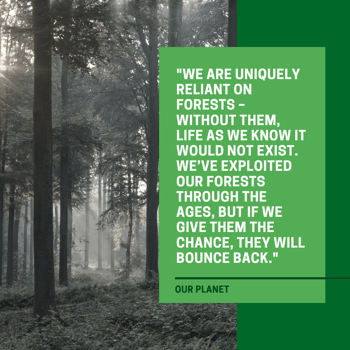
The EUDR will help fight issues caused by deforestation such as biodiversity loss. Forests are home to 80% of Earth’s land animals and plants with many facing extinction due to the destruction of their natural habitats. For example, there are fewer than 600 Sumatran tigers and 65,000 orangutans left today due to deforestation.
Trees create health, soil stability and food security
The impact of deforestation extends beyond wildlife, as it displaces indigenous tribes, erodes soil and pollutes water sources, threatening human health and food security.
Additionally, land use change, primarily deforestation, contributes around 12 to 20% of global greenhouse gas emissions, exacerbating climate change by reducing the number of trees that absorb these harmful gases.
The EUDR aims to counter these harmful effects by promoting deforestation-free supply chains, helping reduce the EU's contribution to greenhouse gas emissions, protecting human rights, and ensuring that the demand for commodities does not drive further environmental harm or social injustice.
What is the Timeline for the EUDR?
When do companies need to comply?
- Large and medium-sized companies: 30 December 2026
- Most micro and small operators: 30 June 2027. (Micro and small operators handling products already covered by the EU Timber Regulation follow the 30 December 2026 date.)
- 30 December 2027: Newly added products under expanded classifications come into scope. These include soluble (instant) coffee and coffee extracts, essences, and concentrates, certain palm oil derivatives and frozen cattle tongues.
Is your business a micro, small, medium or large operator?
For EUDR purposes, business size is based on the categories in Article 3 of the EU Accounting Directive. These consider annual net turnover, balance sheet total and the average number of employees during the financial year.| Business size | Annual net turnover | Balance sheet total | Average employees |
|---|---|---|---|
| Micro | Up to €900,000 | Up to €450,000 | Up to 10 |
| Small | Up to €10 million | Up to €5 million | Up to 50 |
| Medium | Up to €50 million | Up to €25 million | Up to 250 |
| Large | More than €50 million | More than €25 million | More than 250 |
Classification depends on at least two of the three criteria. Businesses should check the smallest category they qualify for first. Medium-sized businesses exclude those classified as micro or small, while large businesses exceed at least two of the medium-sized thresholds.
These are the EU Accounting Directive’s baseline thresholds. Some EU Member States use higher financial thresholds for small businesses, up to €15 million annual net turnover and €7.5 million balance sheet total. Confirm your classification with your finance or legal team, including applicable national thresholds and rules on changes in size over consecutive financial years.
What has changed since the EUDR was agreed?
Scope refined:
- Books, newspapers and printed pictures were removed from scope in December 2025.
- Simplified due diligence obligations: Requirements were streamlined to reduce administrative burden, particularly for lower-risk operators in December 2025.
- Cattle hides, skins, and leather were removed from the regulation's scope via Delegated Regulation in September 2026.
What does EUDR compliance require in practice?
EUDR compliance consists of meeting three main requirements:
- Deforestation Free: Under the EUDR, companies placing products on the EU market or exporting them from the EU must ensure the products come from land that wasn't deforested after 31st December 2020.
- Legally Produced: The production of these products must comply with all relevant laws and regulations of the country in which they were produced.
- Due Diligence: Businesses are required to provide traceability information across their supply chain.
- Upstream operators generally gather production and geolocation data, assess risk and mitigate it where required. They submit a due diligence statement before placing an in-scope product on the EU market or exporting it.
- Eligible micro and small primary operators in low-risk countries can submit a one-off simplified declaration.
- Downstream operators and traders must keep supplier and customer records for at least five years.
- The first downstream buyer also must keep the statement reference or declaration identifier for five years.
- Non-SME downstream operators and traders must also register in the EU’s Information System.
- Certification schemes may support compliance, but certification alone is not sufficient under the EUDR.
What Products are in scope of the EUDR?
The EUDR applies to the following products and commodities:
- Relevant Commodities: cattle, cocoa, coffee, oil palm, rubber, soya and wood.
- Relevant Products: products derived from relevant commodities including certain cattle meat products, chocolate, glycerol, natural rubber, tyres, soya-bean oil and wooden furniture.
- Products in the scope of the regulation are detailed in Annex 1 by their custom codes.
Out of scope: Books, newspapers and printed pictures were removed in December 2025. Bovine hides, skins and leather were removed in September 2026. Cattle remain a relevant commodity.
The scope of products will be reviewed periodically, with the next major policy review scheduled for 2030, and businesses should monitor regulatory updates closely.
The EUDR applies regardless of whether such items are produced in the EU or imported from outside the EU.
What penalties are there for non-compliance?
EU-appointed enforcement authorities will carry out risk-based checks using a sample of operators/traders in different regions. The annual minimum proportions are 1% for low-risk, 3% for standard-risk and 9% for high-risk origins, covering operators and non-SME downstream operators and traders.
Fines
Fines will be proportionate to the environmental damage and the value of the commodities or products concerned. In the most serious cases, operators and traders may face fines of up to 4% of their annual EU-wide turnover in the financial year before the fining decision. The maximum must be increased where necessary to exceed the economic benefit of the infringement. This could amount to millions of euros for bigger firms.
Restricted Market Access
Non-compliance with the EUDR can lead to an immediate ban on selling into the EU market, as well as the confiscation of the relevant commodities or products and confiscation of revenues gained from the relevant commodities and products concerned, leading to severe business and reputational loss.
The EUDR further allows for temporary exclusion from public procurement processes and access to public funding, including temporary prohibition from placing or exporting relevant products and prohibition from the use of the simplified due diligence system.
Reputational Damage
Failure to act on legislation and certification, causing failure to comply, will invite negative consequences in the public sphere, including harmful press coverage, potential boycotts of products, damage to brand reputation, and reduced consumer brand loyalty, all ultimately impacting the bottom line. Such damage takes time, effort and investment to recover from, so it is best to avoid it.
6 Key steps to follow for EUDR compliance
To comply with the EUDR regulation, companies must take a series of steps to align their supply chains with deforestation-free requirements.
1. Assess Your Compliance Requirements
Companies need to evaluate if the EUDR applies to their operations, especially if they sell products in the EU. Even businesses outside the EU need to engage with their European partners by sharing necessary data. It's important to determine whether your products are covered under the regulation’s designated commodity list and understand the different obligations of operators, traders, and SMEs. So, do your retail products that originate from cattle, cocoa, coffee, palm oil, rubber, soya, and wood, or any of the derived products as listed in the legislation, come from areas suffering from deforestation? Only by having supply chain visibility will you be able to answer that question in good faith.
2. Align Internal Teams
Once you confirm your obligations, internal teams must work together for effective compliance. Procurement teams should engage suppliers; sustainability teams can guide deforestation-free strategies and risk management should incorporate EUDR-specific due diligence procedures. Legal teams can help confirm your regulatory responsibilities and ensure everyone is prepared for compliance.
3. Create a No-Deforestation Policy
Develop a clear no-deforestation policy that aligns with the EUDR's guidelines. This policy should include cut-off dates no later than 2020 for deforestation. It should also include commitments to protecting human rights, particularly the rights of indigenous peoples. Set responsible sourcing standards for your suppliers and ensure internal governance is in place to enforce the policy.
4. Strengthen Supplier Relationships and Improve Traceability
Engaging with suppliers is essential for collecting the necessary data, such as geolocation information of farms or forests where products originate. Ensure your data collection tools are effective and integrated with risk management systems. This will help verify that products in your supply chain are deforestation-free and legally sourced. Segura’s traceability software enables companies to capture geolocation data and plot boundaries for each supplier using third-party data sourced from Global Nature Watch.
5. Implement Ongoing Monitoring
Monitoring tools such as satellite imagery and geolocation data allow companies to track deforestation risks in their supply chains. Companies are responsible for detecting and responding to any deforestation that may occur. Using recognised platforms and monitoring solutions such as Segura’s mapping software will help ensure compliance and mitigate potential issues.
6. Collaborate Beyond Your Supply Chain
Beyond compliance, forming partnerships outside your supply chain is key to supporting broader deforestation-free efforts. Collaborate with stakeholders across industries, landscapes, and jurisdictions to create a larger impact. Join policy efforts and multi-stakeholder initiatives to contribute to the lasting success of the EUDR.
At Segura, we have teamed up with Canopy Planet, an organisation which works with global companies to find groundbreaking solutions that transform supply chains. Their goal is to prevent the destruction of forests, ensuring they are not used for disposable products like packaging or clothing.
Another example is Forests Forward, a WWF initiative that partners with businesses to protect and restore forests globally. By offering expert guidance and support, the programme helps companies commit to sustainable practices, invest in forest landscapes, and improve forest management.
What other deforestation legislation and certification matters for retailers and brands?
In reaction to consumer pressure, retailers want to work with suppliers who are openly compliant with certification and legislation. EUDR compliance will be an important piece of legislation that consumers will be aware of when purchasing items.
Businesses should also ensure they conform to the UK Environment Act which came into force in 2021. The law allows the use of forest-risk commodities and their derivatives in business only if there is compliance with all relevant local laws.
What more can fashion brands do to stop deforestation?
Alarmingly, over 200 million trees are felled annually to make cellulosic fabrics like viscose for clothing. To combat this, fashion brands and retailers must prioritise sourcing materials certified 'deforestation-free' and invest in innovative, plant-based alternatives that don't rely on tree felling. Removing virgin trees in the production of Man-Made Cellulosic Fibres (MMCF) by investing in closed-loop textile-to-textile recycling holds significant potential. (We investigate sustainable closed-loop alternatives to viscose in this Sustainable Sourcing challenges article.)
Cattle grazing is another driver for deforestation around the world, and fashion retailers are vulnerable to sourcing leather from affected areas. Greater transparency of the long and complex supply chains for leather is a first step, then sourcing from verified deforestation and conversion-free cattle farms. We look at the possibilities of sustainable leather production in our Net Zero Material Transition article on Leather.
“Textile Exchange and Leather Working Group (LWG) are co-leading the Deforestation-Free Call to Action for Leather, which asks brands to commit to sourcing their bovine leather from deforestation-free supply chains by 2030 or earlier”
Deforestation-Free Call to Action for Leather
As well as complying with legislation, companies should also try to ensure sustainability in other ways. As consumers are becoming increasingly aware of the impacts of our forests being destroyed, they are making more informed choices, and thus driving change in retailers and brands.
Forest use needs to be carefully managed by replacing what we take, and replanting young trees to replace older trees. The number of new tree plantations is growing each year, but we also need to slow down the rate of deforestation by using less virgin wood and recycling more.
FSC Certification
The Forest Stewardship Council (FSC) is an international, non-governmental organisation dedicated to promoting responsible management of the world’s forests. Forests are inspected and certified against strict standards. In addition to forest certification, the FSC system includes a certified chain of custody that tracks the timber through the supply chain from the forest to the final user.
Consumers may look for the Forest Stewardship Council-approved logo on the products they purchase.
Sustainable packaging
On one hand, we want to reduce plastic packaging, and we want to use a sustainable source instead. On the other hand, we need to stop deforestation. Trees and wood pulp are great sustainable materials, if retailers ensure that paper, card and cardboard are sustainably sourced from FSC-certified wood-pulp, or that they are produced from recycled material. In addition, retailers need to increase packaging efficiency to use less where possible and ensure packaging can be easily recycled at home.
For EUDR purposes, check the customs code and how the packaging is supplied or used. Listed packaging sold as a product in its own right can be in scope. Ordinary packaging used solely to support, protect or carry another product is generally excluded.
How can Segura support you in EUDR compliance?
The best place to start is to download our EUDR factsheet with recommended steps to follow for compliance, including what to include in Due Diligence Statements.
Segura can support EUDR compliance by providing:
- Supply Chain Mapping: visualise the entire supply chain, ensuring companies can trace the origin of products which are regulated by EUDR.
- Data Collection and Validation: Segura provides companies with a centralised platform which captures and validates essential supplier data, such as geolocation information to capture supplier boundaries, ensuring products meet deforestation-free requirements.
- Deforestation Analysis: Segura can collaborate with Global Nature Watch to collect data for each facility declared to support deforestation analysis. This includes displaying areas where tree cover change has occurred and tracking changes over time.
- Risk Data and Risk Monitoring: Segura can import third-party data, such as the Corruption Perceptions Index, to identify suppliers located in high-risk countries which may require further corroborating evidence. Segura can monitor information collection to identify and alert retailers to any gaps or potential risks.
- Transparency and Monitoring: The software improves visibility and transparency across multi-tier suppliers, making it easier to monitor compliance with EUDR’s due diligence and traceability obligations.
- Centralised Communication: It keeps supplier communications in one place, ensuring ongoing updates and adherence to EUDR regulations.
By managing data and supplier relationships effectively, Segura helps ensure companies meet the EUDR's requirements for deforestation-free and legally sourced products.
Segura offers a solution to retailers
Get a grip on leather, viscose and packaging sourcing to ensure compliance
Retailers and brands need clarity and transparency in their supply chain to ensure they partner with suppliers that source ethically. Ensuring transparency within supply chains, confirming that those nominated routes are being adhered to, and being able to see that suppliers’ certifications are valid, is vital to drive change. Being able to audit, track and prove compliance is increasingly important to be able to trade at all.


